
The Jackery HomePower 3600 Plus is a high-capacity portable power station designed for home outages, hurricane preparation, RV travel, off-grid camping, job sites, and emergency backup power. This review examines its battery capacity, output, expected appliance runtimes, charging options, solar compatibility, portability, UPS function, and expandable 240-volt capabilities.
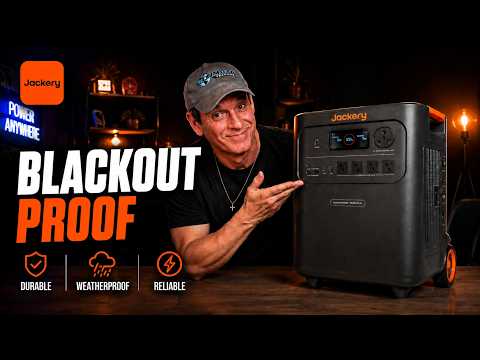
The Jackery HomePower 3600 Plus is a large lithium iron phosphate portable power station with 3,584 watt-hours of stored energy. It supplies up to 3,600 watts of continuous AC output and can accommodate short startup surges of up to 7,200 watts.
Those numbers place it well above the small power stations commonly used for phones, laptops, and weekend camping. The HomePower 3600 Plus is intended for larger loads such as refrigerators, medical equipment, televisions, routers, RV systems, workshop tools, and selected household circuits.
| Specification | Jackery HomePower 3600 Plus |
|---|---|
| Battery capacity | 3,584Wh, approximately 3.6kWh |
| Battery chemistry | LiFePO4 lithium iron phosphate |
| Continuous output | 3,600W |
| Peak surge output | Up to 7,200W |
| Estimated cycle life | Approximately 6,000 charge cycles |
| Weight | Approximately 73.9 pounds |
| Expandable capacity | Up to approximately 21kWh with compatible battery packs |
| Maximum solar input | Up to 1,000W with a compatible solar configuration |
One of the most noticeable differences between a battery power station and a conventional gas generator is noise. A gas generator operating under load may be loud enough to disturb neighbors, interfere with sleep, or make indoor conversation difficult.
The HomePower 3600 Plus operates at a much lower sound level and does not create engine exhaust. That makes it useful inside a home, RV, workshop, garage, or other enclosed area where a fuel-powered generator would be unsafe.
The 3,600-watt continuous inverter can run many common household appliances individually or in combination, provided their total continuous demand remains within the unit's output limit. Its higher surge rating helps with devices containing compressors, pumps, and motors.
High-demand appliances must still be evaluated carefully. Space heaters, electric dryers, central air conditioners, well pumps, electric water heaters, and other large loads may require 240-volt service or consume energy quickly.
Runtime is determined by usable battery capacity, appliance power consumption, inverter efficiency, temperature, and how frequently an appliance cycles on and off. Dividing 3,584Wh by an appliance's wattage provides a theoretical estimate, but real-world runtime will usually be lower.
| Device | Example Average Draw | Approximate Runtime |
|---|---|---|
| Full-size refrigerator | 150W | Approximately 19 to 22 hours |
| CPAP machine | 30 to 60W | Multiple nights, depending on settings and humidifier use |
| Router and modem | 20W | Approximately five to six days |
| 50-inch LED television | 100W | Approximately 28 to 31 hours |
| Combined 320W emergency load | 320W | Approximately nine to ten hours |
These figures are estimates, not guarantees. Actual power consumption can differ substantially between appliance models.
A large portable power station can provide meaningful protection during hurricanes, severe storms, wildfires, rolling blackouts, and other emergencies. It can keep refrigerated food and medication cold, maintain internet access, power lights, and support essential medical devices.
Preparation should happen before a storm is named or an outage begins. Portable power stations, batteries, solar panels, extension cords, and other emergency supplies may become difficult to find as a major weather event approaches.
For extended outages, compatible expansion batteries can increase total storage to approximately 21kWh. Solar charging can also replace some of the energy used during the day, although output varies with panel size, weather, season, shading, and panel position.
The HomePower 3600 Plus includes a TT-30 outlet commonly used by RVs and travel trailers. This allows many RV electrical systems to connect directly to the power station without a running gas generator or campsite power connection.
Runtime will depend heavily on whether the RV air conditioner, microwave, electric water heater, or other high-demand appliance is operating. A modest overnight load consisting of lights, a small refrigerator, water pump, fan, and device charging can run much longer than an RV using air conditioning continuously.
Solar panels can help replenish the battery during daylight. Two 200W panels provide up to 400W nominal under ideal conditions. The HomePower 3600 Plus can accept up to 1,000W of compatible solar input when paired with a larger panel configuration.
Contractors may find the unit useful for interior renovations, finished carpentry, roofing, remote work locations, and workshops where generator fumes or engine noise create problems.
The 3,600-watt continuous output can support many common tools, including circular saws, reciprocating saws, drill presses, air compressors, and shop vacuums. Multiple tools may be operated together when their combined running and startup requirements remain within the power station's limits.
The built-in wheels and retractable handle make the approximately 73.9-pound unit easier to move across hard surfaces. It remains a substantial piece of equipment, however, and may require two people to lift into a vehicle or carry over stairs.
The unit includes an uninterruptible power supply function. When connected between a wall outlet and compatible equipment, it can switch to battery power after a utility outage.
This can help keep desktop computers, networking equipment, communications devices, and other electronics operating through brief interruptions. Users should still verify that the transfer time and power characteristics meet the requirements of particularly sensitive or medically critical equipment.
One HomePower 3600 Plus primarily provides 120-volt output. Two compatible units can be joined through the appropriate Jackery parallel system to provide true 240-volt output and up to 7,200 watts of continuous power.
This creates a future expansion path for households that may eventually need to support selected 240-volt equipment. Such equipment can include certain well pumps, dryers, electric water heaters, air-conditioning systems, and household circuits.
Connecting portable power equipment to home wiring requires compatible transfer equipment and proper installation. Consult a qualified electrician and follow all manufacturer instructions and local electrical codes.
The HomePower 3600 Plus may be a strong fit for people who:
This unit may be unnecessarily large and expensive for someone who only wants to recharge phones, tablets, laptops, cameras, lights, or small camping accessories. A smaller Jackery Explorer model may provide adequate capacity while being lighter and easier to carry.
It may also be unnecessary for a home that already has a permanently installed whole-home standby generator. The HomePower 3600 Plus fills the space between small portable batteries and a fully installed home backup system.
The Jackery HomePower 3600 Plus combines substantial battery storage, strong AC output, quiet operation, expandable capacity, RV connectivity, solar compatibility, and an optional path to 240-volt power.
Its primary disadvantages are price and weight. Those tradeoffs are expected for a power station capable of supporting large appliances and critical household loads. For hurricane preparation, RV use, off-grid power, job sites, or home emergency backup, it provides a flexible alternative to relying exclusively on a gas generator.
```html
A huge thank you to Jackery for sponsoring this video. Today, I have something very special to show you, and I also have something special to give away.
To enter the giveaway, leave a comment below explaining what you would do with this Jackery system. Where would you take it, and what would you plug into it? You may leave one comment per day for the next 10 days. After 10 days, one winner will be selected, and the prize will be shipped to the winner.
Please leave a thumbs-up as well. Now, let us move on to the video.
This power station is running a refrigerator, a television, and two lights at the same time. Can you hear it? Listen.
There is virtually no sound. That is what 3,600 watts of quiet battery power sounds like.
For comparison, a gas generator producing this amount of power may operate at approximately 70 decibels. That can sound like loud machinery running on your patio in the middle of the night and may result in some unhappy neighbors.
This power station operates at a much lower sound level. I am Michael Scott from Ultimate Tech Hub. Over the next several minutes, I will show you what this power station can operate, how long it may last on one charge, and four different ways to recharge it.
At the end of the video, I will also explain one feature that very few portable power stations in this category can offer.
This is the Jackery HomePower 3600 Plus power station. It can also be paired with compatible Jackery SolarSaga solar panels, which are sold separately.
If you want to replenish the battery while camping, traveling, or living off the grid, compatible solar panels can be a valuable addition.
Let us begin with the actual specifications. Once you understand what is inside the power station, its capabilities become much easier to evaluate.
The battery capacity is 3,584 watt-hours, which is approximately 3.6 kilowatt-hours. That represents a substantial amount of stored electricity for a portable unit.
The battery uses lithium iron phosphate, or LiFePO4, chemistry. This chemistry is widely used in modern power stations because of its thermal stability, long service life, and ability to withstand thousands of charging cycles.
The battery is rated for approximately 6,000 charge cycles. At one cycle per day, that could represent more than 16 years of daily cycling, although actual longevity will depend on use, temperature, charging practices, storage, and other conditions.
The inverter supplies 3,600 watts of continuous output with a peak surge rating of up to 7,200 watts.
The continuous rating is what matters when operating appliances over an extended period. It can support a full-size refrigerator, television, router, several lights, and multiple charging devices at the same time, provided the combined load remains within the output limit.
The 7,200-watt surge capacity helps handle the brief startup demand created by compressors, pumps, air conditioners, and other motor-driven equipment. Some of these appliances briefly require two or three times their normal running wattage when they start.
The HomePower 3600 Plus weighs approximately 73.9 pounds. That is substantial for a portable product, but Jackery includes wheels and a retractable pull handle.
It can roll across hard floors in a manner similar to a large suitcase. The wheels and handle make it much easier to move, although lifting it into a vehicle or carrying it up stairs may still require assistance.
Jackery uses cell-to-body technology that integrates the battery-cell structure into the body of the unit. This helps reduce its overall dimensions and weight compared with some power stations offering similar capacity.
The price of this unit varies based on available promotions, bundles, and seasonal sales. Jackery frequently offers discounts, so it is worth checking the current price rather than automatically paying the full suggested retail price.
I previously purchased a smaller Jackery Explorer model during a sale and received a significant discount. If a major promotional event is approaching, waiting for the sale may reduce the purchase price considerably.
Search for the current Jackery sale or use the product link in the video description. Prices and discounts can change, so confirm the actual offer before placing an order.
The HomePower 3600 Plus includes more output options than many users will ever need, but understanding the ports helps clarify what can be connected.
The front of the unit has four standard 120-volt, three-prong AC outlets. These can support appliances such as a refrigerator, microwave, television, lamp, coffee maker, game console, or other equipment with a standard household plug.
All four AC outlets can be used simultaneously, but their combined load must remain within the power station's total output rating.
The unit also includes a 30-amp TT-30 RV outlet. This is a common shore-power connection used by many RVs and travel trailers.
With the correct cable and a compatible RV, one connection allows the power station to supply the RV's electrical system without running a generator or connecting to a campsite pedestal.
The power station includes two USB-C ports for charging compatible phones, tablets, laptops, and accessories. It also has two USB-A ports for standard USB charging.
DC input connections on the side of the unit are used for compatible solar panels and other supported charging equipment.
This unit is particularly relevant for hurricane preparation. Atlantic hurricane season runs from June through November, with the most active period generally occurring from August through October.
Early in the season is the time to prepare. Waiting until a storm has been named may mean facing empty shelves, delayed shipping, or higher prices.
When a hurricane damages the electrical grid, outages may last for days rather than hours. That makes appliance runtime an important part of choosing an emergency power system.
A full-size refrigerator averaging approximately 150 watts may operate for roughly 19 to 22 hours after accounting for normal energy losses.
Actual runtime will depend on the refrigerator's age, efficiency, thermostat setting, room temperature, compressor cycling, and how frequently the doors are opened.
During an emergency, this can help protect refrigerated food and temperature-sensitive medication.
A CPAP machine drawing approximately 30 to 60 watts could operate for multiple nights on one charge.
Runtime will depend on pressure settings, heated tubing, humidifier use, inverter losses, and whether other equipment is connected.
For someone who depends on a CPAP machine or other essential medical device, backup electricity is more than a convenience. It may be a critical part of emergency planning.
Users should verify the power requirements of their specific medical equipment and discuss backup planning with the equipment provider or medical professional.
A home router and modem drawing approximately 20 watts combined could potentially remain online for five to six days if they were the only devices connected.
Internet access can provide emergency notifications, weather updates, communication with family, and access to local information.
A 50-inch LED television drawing approximately 100 watts could operate for roughly 28 to 31 hours, depending on screen brightness, settings, and actual consumption.
If a refrigerator, CPAP machine, router, and television draw approximately 320 watts together, the combined runtime may be approximately nine to ten hours.
For longer outages, the HomePower 3600 Plus can be expanded with compatible additional battery packs. Connecting up to five expansion batteries can increase total capacity to approximately 21 kilowatt-hours.
At that level, the system can support critical household loads for a much longer period, although actual duration will still depend on how much electricity is being consumed.
The practical lesson is simple: buy and test emergency equipment before it is needed. Do not wait until a hurricane is approaching your home to begin looking for backup power.
The unit also performs well for RV travel and off-grid camping. The 30-amp RV port can function similarly to a campsite shore-power connection for compatible systems.
A typical RV running lights, a water pump, a small refrigerator, device chargers, and a fan may draw several hundred watts. Operating air conditioning, a microwave, an electric water heater, or other high-demand appliances will increase consumption substantially.
At an average draw of approximately 1,000 watts, the usable runtime would be around three hours after normal conversion losses. At a lighter overnight load of approximately 300 to 400 watts, the battery may support roughly eight to ten hours of use.
In the morning, compatible solar panels can begin recharging the system. Solar performance depends on sunlight, weather, shading, panel orientation, and the total rated wattage of the connected panels.
Two SolarSaga 200W panels provide up to 400 watts nominal under ideal laboratory conditions. The power station supports up to 1,000 watts of compatible solar input when connected to a larger solar configuration.
The HomePower 3600 Plus operates quietly compared with a gas generator. This matters when camping near other people, especially during overnight hours.
There is no engine idling beside the RV, no exhaust near the campsite, and no need to disturb neighboring campers simply to keep essential equipment operating.
The 3,600-watt continuous output and 7,200-watt surge rating also make this unit useful on job sites and in workshops where engine noise and exhaust are undesirable.
A circular saw may draw approximately 1,200 to 1,500 watts under load. A reciprocating saw may use around 900 watts, a drill press around 600 watts, and an air compressor around 1,100 watts.
Actual consumption depends on the model, material, operating load, and startup demand. The power station's surge capacity is especially useful for equipment with electric motors, including compressors.
On a roofing project, renovation, or remote work site, the wheeled unit can be moved close to the work area. Depending on the tools involved, it may support two tools at once while also charging a phone or operating a job-site radio.
For interior renovations, finished carpentry, and other indoor work where gasoline-generator exhaust is unacceptable, a battery power station offers a practical alternative.
How a power station is recharged is just as important as what it can operate. The HomePower 3600 Plus supports several practical charging methods.
The primary home-charging method is a standard AC wall outlet. Connect the unit before a storm, trip, or work assignment so it is fully charged when needed.
Wall-charging time depends on the supported input rate, battery temperature, starting charge level, and charging conditions.
Supported AC and DC inputs may be combined to reduce charging time. This may be useful when preparing quickly for a storm, road trip, or other time-sensitive event.
Compatible solar panels allow the unit to recharge away from the electrical grid. This is especially useful during an extended outage or at an off-grid campsite.
The power station supports up to 1,000 watts of compatible solar input. A full recharge time will vary according to the solar array's rated output and real-world sunlight.
A compatible gas generator can be used as an energy source to recharge the Jackery. This allows the generator to operate for a shorter period while the battery provides quieter power afterward.
This arrangement can also separate connected devices from some of the fluctuations produced by lower-quality generator output. Always verify compatibility and follow the instructions for both devices.
The HomePower 3600 Plus includes an uninterruptible power supply function. When utility power fails, the unit can switch connected equipment to battery operation.
This may help keep a desktop computer, router, modem, or other compatible electronics operating through a brief outage.
For extremely sensitive electronics or life-support equipment, confirm that the transfer time and electrical specifications meet the equipment manufacturer's requirements.
One of the most notable features is the ability to connect two compatible HomePower 3600 Plus units through the appropriate Jackery parallel system.
This configuration can provide true 240-volt output with up to 7,200 watts of continuous power.
Why does 240-volt output matter? Some of the largest appliances and systems in a home operate at 240 volts. These may include an electric dryer, well pump, central air-conditioning compressor, electric water heater, or other major equipment.
A 120-volt-only portable power station cannot directly operate a 240-volt appliance. Connecting two compatible units creates an expansion path for people whose backup-power needs grow over time.
Most buyers may never need two units, but the option provides useful flexibility. Home electrical connections require appropriate transfer equipment and should be evaluated or installed by a qualified electrician.
You may want to consider this unit if you live in an area that experiences frequent power outages or hurricanes.
It may also be appropriate if someone in your home depends on equipment such as a CPAP machine or oxygen concentrator that cannot easily remain offline.
RV owners, off-grid campers, and contractors working indoors may also benefit from its capacity, quiet operation, and lack of exhaust.
It can serve as an alternative to a gas generator for people who do not want to store fuel, perform engine maintenance, or operate combustion equipment near their living space.
This unit is probably more than you need if your main goal is charging a phone, laptop, camera, lights, or a few small camping accessories.
A smaller model in the Jackery Explorer lineup may be easier to carry and considerably less expensive.
Smaller options may include models in the approximate 880Wh, 1,000Wh, or 2,000Wh capacity categories. Select a power station based on the devices you need to run and the required runtime rather than simply purchasing the largest available unit.
The HomePower 3600 Plus may also be unnecessary if your property already has a permanently wired, whole-home standby generator.
It fills the gap between a small portable battery, a conventional gas generator, and a permanently installed whole-home system.
One advantage of remaining within the Jackery product family is that compatible SolarSaga panels may work with multiple power stations.
Compatibility varies by model, connector, voltage range, and input limit, so match each panel configuration to the specifications of the power station being used.
The Jackery HomePower 3600 Plus is a capable power station for hurricane preparation, home backup, RV travel, camping, and professional work.
Its main disadvantages are its weight and price. The wheels and handle make the approximately 73.9-pound unit easier to move, but it is still large and may be difficult for one person to lift.
Equipment with this level of output and capacity is not inexpensive. In exchange, the system requires no gasoline, produces no operating exhaust, avoids regular engine maintenance, and can remain stored indoors until needed.
I give the HomePower 3600 Plus a rating of 9 out of 10. The primary point deducted is for its weight.
Other than that, this is a power station I would consider using in my own home. If you live in a hurricane or severe-storm zone, purchase and test your backup-power equipment before the season reaches its peak.
Which situation would you use this power station for: hurricane preparation, RV travel, camping, a work site, or home backup power?
Leave a comment with your answer. Please also like, share, and subscribe to help Ultimate Tech Hub reach 100,000 subscribers.
I am Michael Scott from Ultimate Tech Hub. I will see you next time.
```
On today\'s episode we will show you how to punch down / terminate an RJ45 jack for a wall plate. All prices for parts and tools ...

Installing Ethernet cables in your Home or Office doesn\'t have to be complicated! This video shows "How To Wire Ethernet Plugs ...

How to Install Cat8 Plug and Cat8 Keystone Jacks. This is the easiest way to install cat 8 into your Home or Business Network.
This is "How to Install a Cat6a Keystone Wall Jack that provides up to 10 Gbps!" Remember you will need 10Gbps compatible ...

On today\'s episode of the Ultimate Tech Hub we are going to show you where the ethernet jack goes to in your house. We have ...

This is the "Easy Ethernet Wall Jack Installation" that uses a 45-degree Cat6 Keystone Jack from SatMaximum. These 45-degree ...